The Leftover Loophole: Solving the Histamine Puzzle Without Cooking Every Day
Life is a beautiful, chaotic dance, and I see you out there doing the work. I see you choosing the organic greens, sourcing the pasture-raised meats, and laboring over the stove because you know your body is a temple that deserves the best architecture.
But sometimes, even when we do "everything right," we feel a lingering fog, a sudden flush, or a digestive rebellion. It’s frustrating when the very food meant to heal you feels like it’s holding you back. This isn't just about a temporary reaction; for many, it’s a perpetual inflammatory fuel. When your "histamine bucket" is constantly brimming, it creates a silent, low-grade fire that counters your best health efforts and can even cause greater systemic harm over time. Often, the hidden accelerant isn't the ingredient itself, but a tiny molecule called histamine—and specifically, how long it’s been sitting in your refrigerator.
The Science and the Solution
In functional medicine, we look at histamines through the lens of total bucket capacity. Histamine is a neurotransmitter and immune messenger—it’s not "bad," it’s essential! But when our "bucket" overflows due to genetics, gut dysbiosis, or—the topic of today—food storage, we experience symptoms.
Biologically, histamine levels in protein-based foods increase through a process called decarboxylation. As bacteria (even the "good" kind) naturally break down the amino acid histidine in your food, it converts into histamine. This process doesn't stop in the fridge; it only slows down.
I want to be direct with you: freshness is a clinical necessity for histamine sensitive souls. Here is how the "Histamine Clock" generally ticks:
- Tier 1: High Risk (48+ Hours) – Traditional meal prepping where you cook on Sunday for the whole week. By Wednesday, that chicken breast is a histamine bomb.
- Tier 2: Moderate Risk (24 Hours) – Leftovers kept in a standard refrigerator overnight.
- Tier 3: Low Risk (Freshly Cooked or Flash Frozen) – Food consumed within 0–2 hours of preparation or frozen immediately.
My Personal Solution: The "Mini-Batch" & Freeze Method
I know the exhaustion. I know that looking at a raw meat and vegetables at dinner time after a long day working can feel like an impossible mountain to climb. You cannot be expected to be a short-order cook 21 times a week. That isn't sustainable, and grace dictates that we find a way to honor your health without sacrificing your peace.
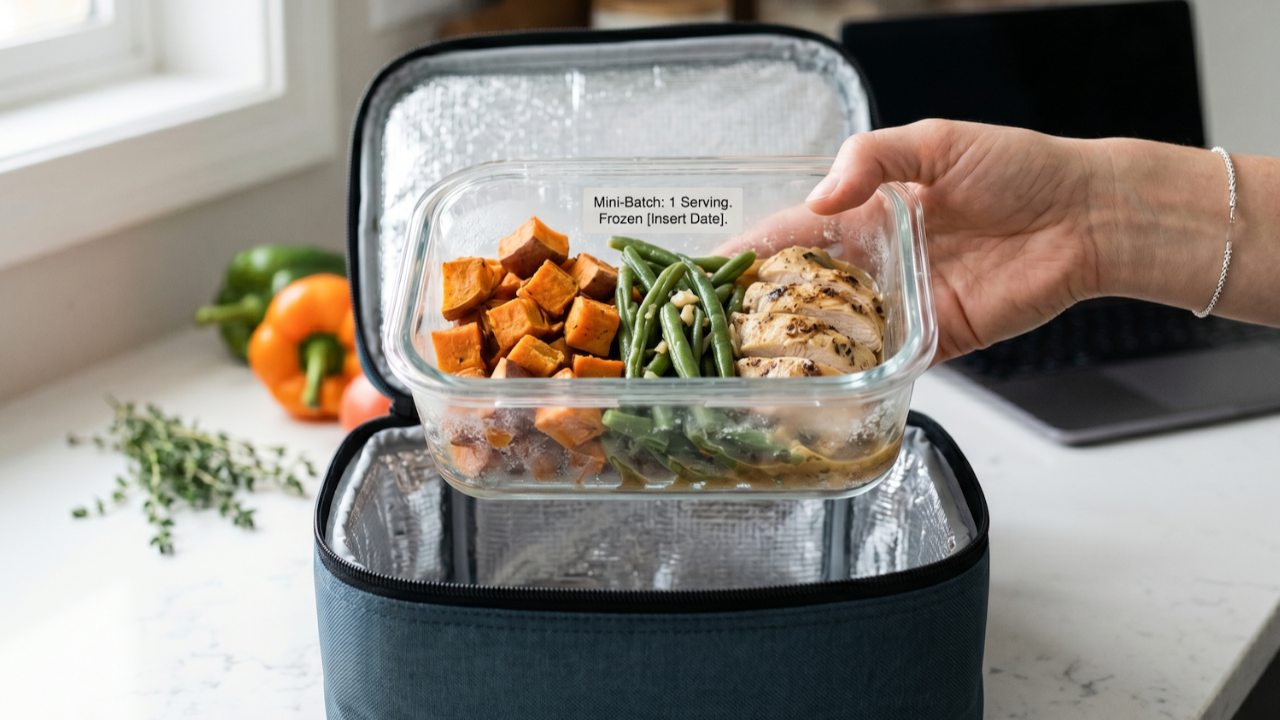
My personal rhythm shifted when I stopped "meal prepping" and started "mini-batching." I cook enough for 2–3 portions, but instead of putting the extras in the fridge, I portion them into glass containers the moment they stop steaming and put them straight into the freezer.
From a biochemical standpoint, the "Freeze-Immediately" method is the "Gold Standard" for histamine management. Freezing halts the bacterial conversion of histidine to histamine. It essentially hits the "pause" button on the chemical clock.
My Process and Tools
- I use specific glass storage containers (click to open) that are thermal-shock resistant and fit perfectly into my portable slow-heater.
- I freeze individual portions immediately.
- About two hours before I want to eat, I place the frozen block into my portable slow-heater (click to open). (BTW this thing also cooks meat from raw in less than 2 hours!)
This slow-thaw and gentle reheat method prevents the "scorching" of proteins that can happen in a microwave, preserving the structural integrity of your nutrients and keeping histamine levels at the baseline they were when first cooked.
Allowances and Exceptions
In my own kitchen, my personal food has a strict rule: meat always goes to the freezer. While I allow some wiggle room for separate roasted vegetables to stay in the refrigerator for a short window (typically 24–48 hours), animal proteins are non-negotiable. The science here is clear: meat contains high levels of the amino acid histidine, which serves as the direct precursor to histamine. The moment a protein source is harvested and cooked, bacteria begin the decarboxylation process, turning that histidine into inflammatory histamine at a rapid pace—even in a cold fridge. Most vegetables, conversely, contain significantly lower levels of these precursor amino acids, meaning their "histamine clock" ticks much slower. By freezing your meats immediately and only "short-term prepping" your veggies, you are strategically lowering the chemical load on your body while still maintaining a manageable daily rhythm.
Exception: While most veggies are safe in the fridge, "histamine-liberator" vegetables or those that are fermented (like spinach, tomatoes, or sauerkraut) are the exceptions that should be treated with the same caution as meat.
The Evidence Base
Research consistently shows that storage temperature is the primary determinant of biogenic amine (histamine) accumulation.
- Cold Chain Management: Studies in Food Control indicate that while refrigeration (4°C) slows histamine production, it does not stop it. Only freezing (-18°C or below) effectively arrests the decarboxylation process.
- The Reheating Factor: Using a slow-heating element or "mini-crock" is superior to microwaving for those with sensitivities, as it reduces the formation of advanced glycation end-products (AGEs) which can further irritate an inflamed immune system.
A Final Word of Hope
You are doing a brave thing by listening to your body. Whether you are a warrior member of Recreating True Health or a client at reGenesis, remember that "perfect" is not the goal—stewardship is.
Keep going. You are worth the extra step of the freezer.
Research References:
- Chung, B. Y., et al. (2017). "Effect of different cooking methods on histamine levels." Annals of Dermatology.
- Visciano, P., et al. (2014). "Histamine poisoning and control measures in fish and fishery products." Frontiers in Microbiology.
- Comas-Basté, O., et al. (2020). "Histamine Intolerance: The Current State of the Art." Biomolecules Journal.